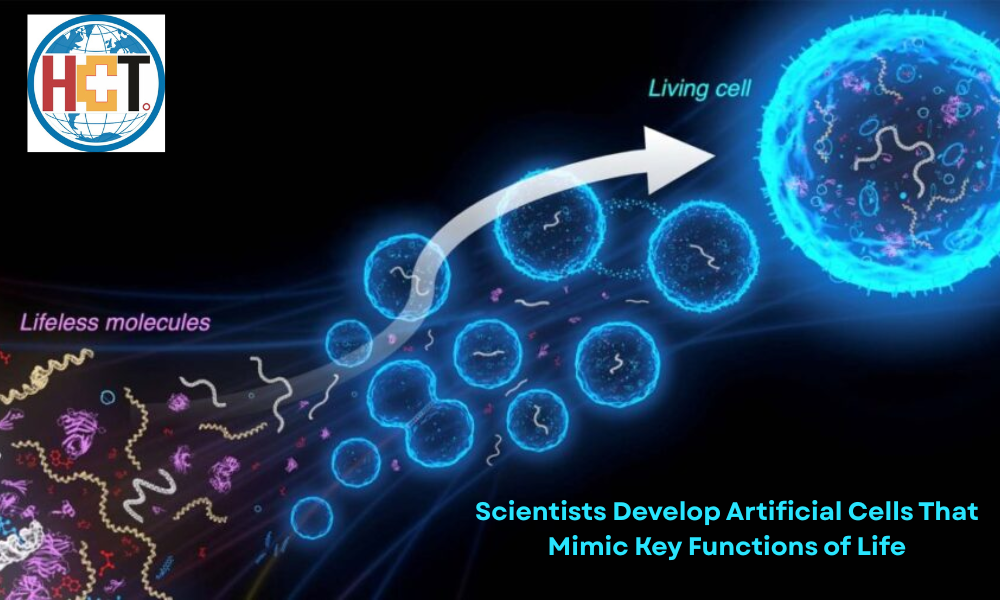
Scientists have taken a major step toward one of biology’s most ambitious goals—creating life-like cells entirely from non-living materials. A research team led by synthetic biologist Kate Adamala at the University of Minnesota has developed artificial cells capable of performing several essential functions associated with living organisms, including feeding, growing, reproducing, and competing for nutrients.
The findings, published on the preprint server bioRxiv on July 2, have not yet undergone peer review. Although the laboratory-made cells are not considered fully alive, researchers say they represent an important proof of concept in the rapidly evolving field of synthetic biology.
A New Milestone in Building Life from Scratch
The artificial cells demonstrate several characteristics traditionally associated with living organisms. They can absorb proteins from their surroundings, increase in size, divide into new cells, and compete with one another for available resources. However, they still fall short of being fully self-sustaining, as they cannot produce all of the internal machinery required for life or continue dividing indefinitely over multiple generations.
According to the researchers, the achievement shows that complex biological behaviours can emerge from carefully assembled molecular components rather than existing only in naturally evolved cells.
A Bottom-Up Approach to Synthetic Biology
Scientists of University of Minnesota have spent decades attempting to recreate living cells in laboratory settings to better understand the origins of life and develop new applications in medicine and biotechnology.
Initially, Adamala’s team focused on replicating natural cell division by simplifying the process. They later shifted to a “bottom-up” strategy, building cells piece by piece to gain a deeper understanding of every biological component involved.
The researchers began with microscopic water-filled spheres enclosed within oily membranes, known as liposomes. Into these structures, they inserted DNA containing just 36 essential genes, sourced from a virus and the bacterium Escherichia coli. By comparison, a typical E. coli cell contains roughly 4,400 genes, highlighting the simplicity of the newly engineered system.
As proteins accumulated inside the synthetic membrane, the structure eventually deformed and split, producing new cells that resembled natural cell division.
Potential Applications Extend Beyond Fundamental Science
The newly created cells, nicknamed “SpudCells” because of their potato-like appearance, could eventually help scientists better understand the basic principles that govern life itself. The name also pays tribute to both the Sputnik era of scientific exploration and Adamala’s Polish heritage.
Although still in the early stages of development, artificial cells could one day contribute to advances in biotechnology, including the production of medicines, industrial chemicals, and biological materials. Researchers believe that refining these simplified cellular systems may also provide valuable insights into how life first emerged on Earth, bringing science a step closer to constructing living systems from the ground up.
Also Read :- CRISPR Technology Achieves New Milestone in Cancer Treatment